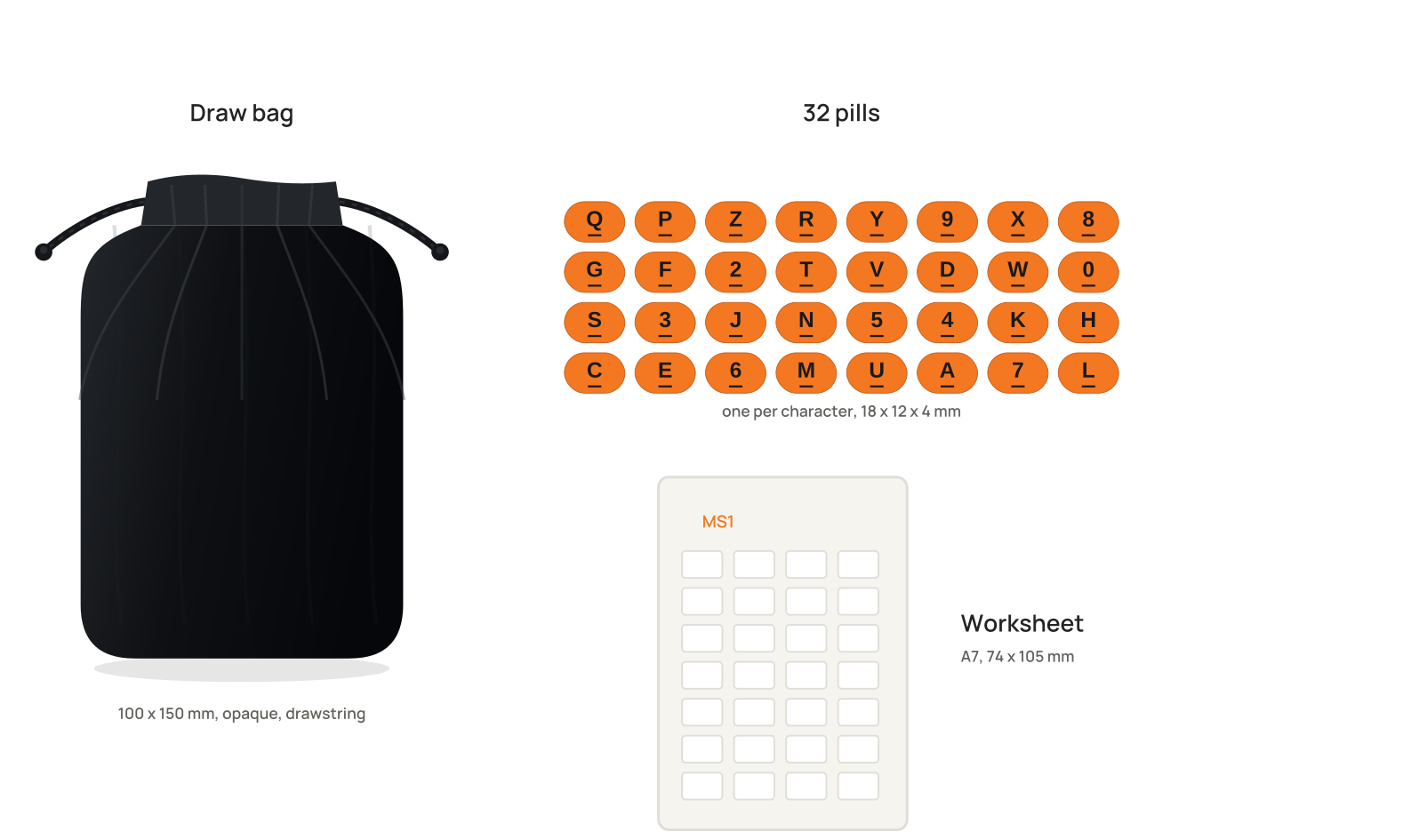
Bech32 order — values 0 to 31
Codex32 encodes data in the bech32 character set: 32 symbols, so every character carries exactly five bits, and the set needs one pill per character. Above they sit in bech32 value order, which is the order the printed set uses: each position is the character's five-bit value, Q = 0 through L = 31. Laying them out this way makes a gap obvious without reading every piece.
Choose your colours
Three colours — white, black and orange. In each pair the body colour comes first and the marking second, laid down as a flush inlay three layers deep. One price whichever pair you choose.
Four characters are missing
B, I and O are not in bech32 at all, because they are too easy to confuse with 8, 1 and 0. The digit 1 is the separator between a codex32 prefix and its data, so it never appears as a drawn character. Write capitals, and remember that 0 is always a zero.
Dimensions
- Pill
- 18 × 12 × 4 mm
- Edge chamfer
- 0.6 mm, both faces, 45°
- Marking depth
- 0.6 mm — three layers, recessed
- Character
- 6.5 mm, Liberation Sans Bold
- Orientation bar
- 4 × 0.6 mm, 4 mm below centre
- Layer height
- 0.2 mm
- Material
- PLA
- Set as printed
- 8 × 4 — 172 × 60 mm
The character sits 0.9 mm above the centre of the face to leave room for the bar below it. The bar is on every pill, letters included: it fixes the reading orientation, which is what keeps 6 from 9, M from W and Z from 2. Lettering is recessed flush rather than raised, so a pill cannot be identified by touch through the bag.
The bag
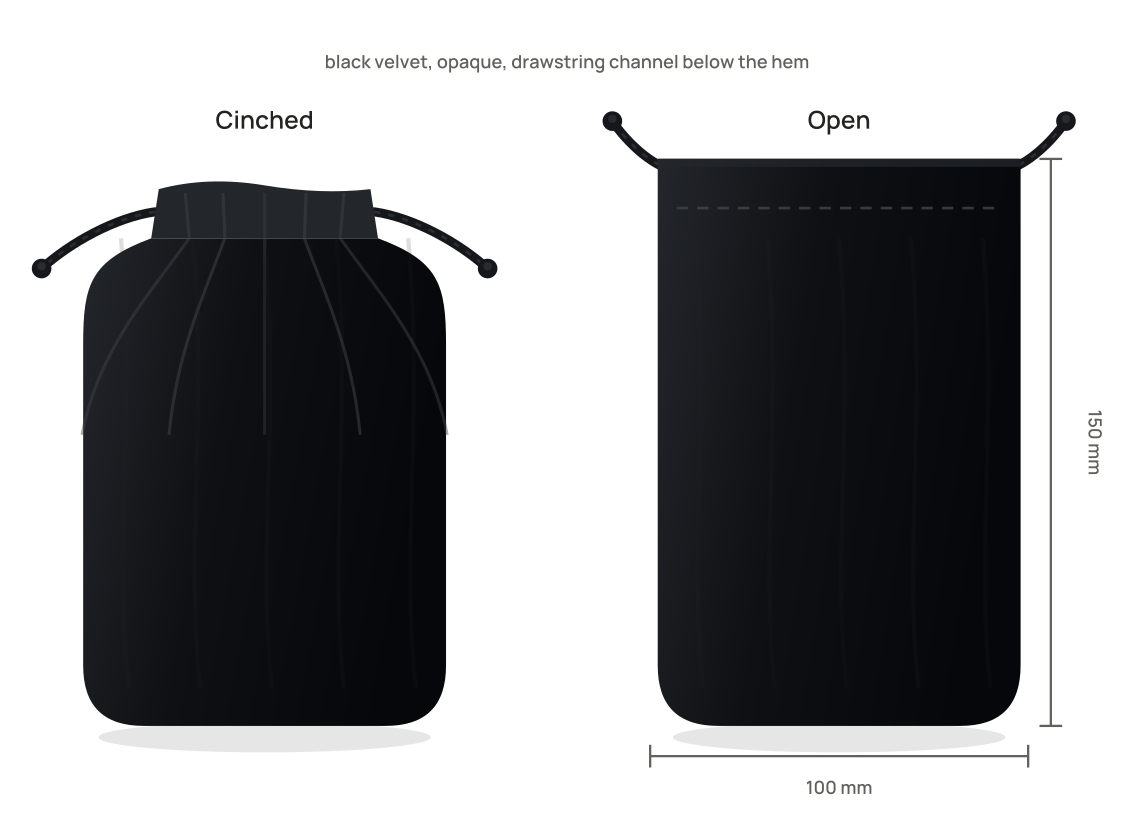
A flat black pouch, 100 × 150 mm, with a drawstring channel below the hem and two cords. Opaque, because a pill you can see is not a pill you drew, and deep enough that 32 pieces actually tumble — mixing is the part the method depends on.
The worksheet
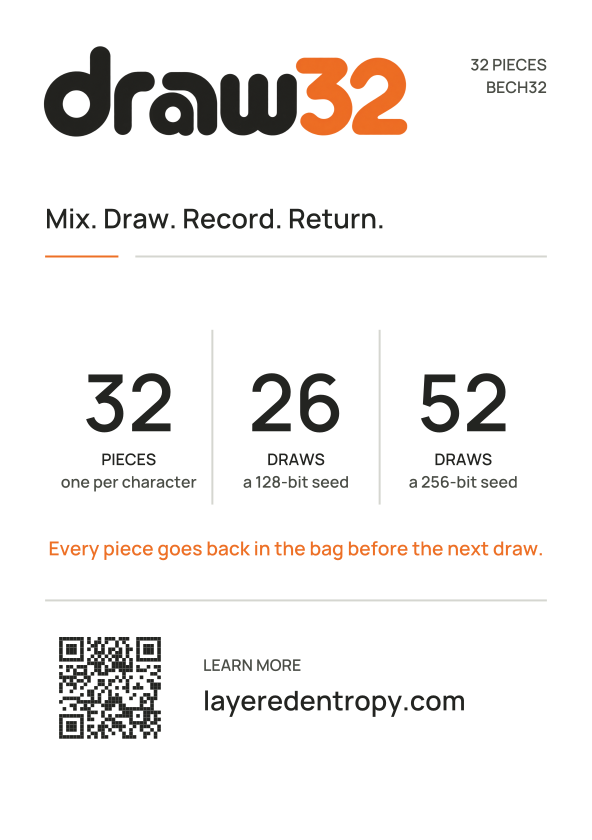
A double-sided A7 card, 74 × 105 mm. One side is the form you write the string onto as you draw; the other carries the figures you need and the one rule the method depends on.
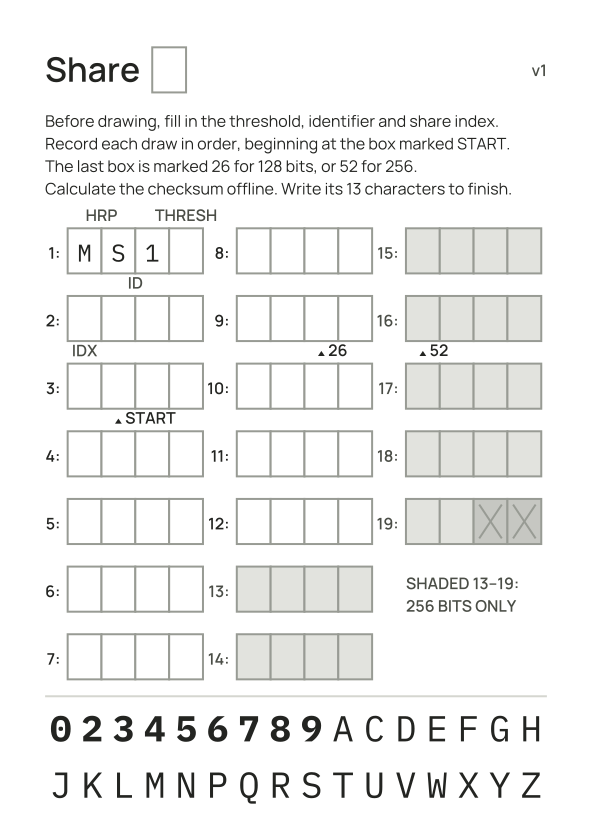
Back: the record form
Nineteen numbered groups of four, so you transcribe and read back in fours rather than as one 48-character run. Groups run down each column, not across the page — 1–7, then 8–14, then 15–19.
The prefix MS1 is printed into group 1, since it is fixed and never drawn; only the threshold beside it is yours. The box marked START, in group 3, is where your first draw goes — not the first box on the card, because the header comes first. Two further boxes are marked 26 and 52: the last drawn box for each seed size. Both fall in the middle of a group, which is why they are marked at all. Everything past your own mark is the 13-character checksum, which you calculate rather than draw.
Groups 13–19 are shaded because only a 256-bit secret reaches them — a 128-bit one ends at group 12 — and group 19 holds two characters, not four. The charset runs along the bottom so you can check a character without putting the card down.
Front: what you need while drawing
The three figures that govern a session — 32 pieces, 26 draws for a 128-bit seed, 52 for a 256-bit one — and the rule underneath them in orange: every piece goes back in the bag before the next draw. It is the side that faces up on the table while the card is in use.
The card is not hosted anywhere yet, so there is nothing for this page to link to.
What an unbiased set has to be
- Identical shape, size, mass and surface finish across all 32 pills.
- Characters that are legible, durable and unambiguous in orientation.
- Lettering flush with the surface, so touch tells you nothing.
- Rounded edges, and enough room in the bag for real mixing.
- A set you can lay out and count, so a missing or duplicated pill is obvious before you start.
Equal outer geometry does not guarantee equal mass: colour coverage, material density, infill, seams and print defects all still need checking before a set can be called unbiased. The five-bits-a-draw figure assumes draws that are independent, uniform and thoroughly mixed — the procedure and the bag establish that, not the printing.
One kit, one price
- Selected
- Black body, orange characters
Checkout is not connected to this page yet.